


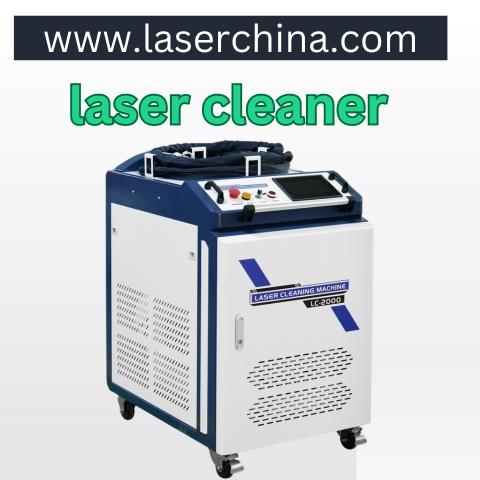
In the industrial world, the demand for efficient, precise, and non-destructive cleaning methods has grown tremendously. Traditional cleaning techniques often involve chemicals, abrasives, or mechanical tools that can damage surfaces, create waste, or require significant downtime. In contrast, the laser cleaner has emerged as a revolutionary solution—transforming how industries handle surface preparation, rust removal, coating stripping, and restoration.
A laser cleaner uses highly focused laser beams to remove unwanted layers like rust, paint, grease, or oxide from metal and other materials without damaging the base. This innovative method has quickly gained attention across industries such as manufacturing, aerospace, automotive, shipbuilding, and even cultural heritage restoration. Its precision, speed, and eco-friendly operation make it one of the most versatile technologies available today.
Understanding the Science Behind a Laser Cleaner
The working principle of a laser cleaner is based on laser ablation. A pulsed laser beam is directed toward the surface, where it interacts with the contaminant layer. The energy from the beam heats and vaporizes the unwanted material, while the underlying substrate remains intact due to the controlled wavelength and energy intensity. This process leaves a clean, polished surface ready for welding, coating, or further processing.
The key lies in the interaction between laser light and matter. Different materials absorb laser energy differently. The laser cleaner can be adjusted in terms of wavelength, pulse duration, and intensity to target specific contaminants while preserving the base material. For example, a rusted steel part can be cleaned with pinpoint accuracy, removing only the oxidized layer while leaving the metal surface unharmed.
This scientific precision ensures consistent and repeatable results—ideal for industries where surface integrity directly affects performance and longevity.
Industrial Applications of Laser Cleaner Technology
The versatility of the laser cleaner makes it suitable for a wide range of applications across multiple sectors:
-
Metal Surface Preparation – Before welding, coating, or bonding, surfaces must be free from rust, oil, and oxidation. A laser cleaner efficiently prepares surfaces without introducing contaminants or residues.
-
Automotive Maintenance – Automotive parts, molds, and dies often accumulate grease and corrosion. A laser cleaner restores their surface condition quickly, helping improve production efficiency.
-
Aerospace Component Care – Precision parts in the aerospace industry require meticulous cleaning standards. The laser cleaner ensures surfaces are pristine without compromising tolerances.
-
Cultural Heritage Restoration – Laser cleaning is used to remove soot, grime, and oxidation from historic artifacts, monuments, and sculptures. It preserves delicate details that traditional cleaning might destroy.
-
Electronics Manufacturing – Circuit boards and electronic housings benefit from laser cleaning to eliminate micro-scale contaminants, ensuring better adhesion and conductivity.
-
Shipbuilding and Marine Maintenance – Hulls, decks, and structural parts affected by saltwater corrosion can be cleaned efficiently using a laser cleaner, reducing maintenance time and material loss.
The Rise of Laser Cleaner in Sustainable Manufacturing
As industries move toward sustainability, the laser cleaner aligns perfectly with eco-friendly goals. Traditional cleaning processes rely heavily on chemical solvents and blasting media, which generate toxic waste and pose disposal challenges. In contrast, laser cleaning is a dry, contactless, and chemical-free method.
It eliminates the need for consumables, minimizes waste, and reduces the overall carbon footprint of industrial operations. This shift not only promotes cleaner production lines but also enhances worker safety by reducing exposure to hazardous materials. Many companies now see the laser cleaner as an essential part of their green transition strategies.
Performance and Precision That Redefine Industry Standards
One of the most remarkable aspects of the laser cleaner is its precision. The laser can be fine-tuned to achieve selective cleaning—removing only the unwanted layer with micron-level control. This makes it suitable for delicate surfaces, intricate geometries, and high-value components where accuracy is critical.
Laser cleaning systems also support automation. They can be integrated into robotic arms or CNC setups, enabling consistent performance in large-scale operations. The automation capability ensures uniform results across hundreds of parts, boosting productivity without manual intervention.
Furthermore, the technology supports both handheld and stationary models. The handheld laser cleaner offers portability for on-site work, while fixed units are used in manufacturing lines for continuous operation. This flexibility ensures suitability across industries regardless of project scale.
Maintenance and Operational Efficiency
Unlike traditional cleaning methods, a laser cleaner requires minimal maintenance. There are no consumables to replace or residues to manage. The laser source, optics, and cooling system need periodic inspection to ensure optimal performance.
The system’s longevity depends on environmental conditions, usage frequency, and adherence to maintenance schedules. Operators typically undergo training to understand laser safety and operational parameters. Once set up correctly, the equipment delivers consistent performance for years, reducing overall maintenance costs.
Downtime is also minimized, as the laser cleaner is always ready to use—requiring no preheating, solvent preparation, or cleanup afterward. The simplicity of operation, combined with the ability to switch between different cleaning tasks instantly, makes it an indispensable tool in modern workshops.
Economic and Productivity Impact
Adopting a laser cleaner can significantly improve production efficiency. Since the process is fast, contactless, and precise, it allows manufacturers to reduce cycle times, avoid rework, and maintain high-quality standards.
While the initial investment may seem high, the long-term savings in consumables, labor, and maintenance justify the cost. The reduced dependency on chemicals also cuts recurring expenses associated with storage, handling, and disposal.
From an operational perspective, the laser cleaner ensures consistency—every cleaned surface meets the same standard, improving downstream processes like coating adhesion, welding integrity, and bonding reliability. This reliability translates into better overall product quality and reduced rejection rates.
Technological Advancements and Future Prospects
Modern laser cleaners are evolving rapidly. Manufacturers are integrating smart sensors, AI-based control systems, and real-time monitoring to optimize cleaning parameters automatically. These enhancements improve accuracy, adapt to surface variations, and ensure uniform cleaning without human oversight.
The trend toward miniaturization and portability continues to shape the future of the laser cleaner market. Compact models with high power efficiency are increasingly being developed for field operations and maintenance crews.
Additionally, research is ongoing to expand the range of materials that can be safely cleaned using laser technology. From delicate composites to heavy-duty metals, the laser cleaner is expected to become an even more universal solution in industrial cleaning and surface preparation.
Environmental and Safety Considerations
Laser cleaning not only promotes sustainability but also ensures a safer work environment. The absence of toxic fumes, abrasive particles, or chemical reactions minimizes health risks for operators. Proper ventilation and protective eyewear remain essential, but the overall safety profile is far superior to traditional methods.
Furthermore, waste material from the laser cleaner process is minimal—often limited to microscopic dust particles that can be easily collected through filtration systems. This significantly reduces environmental contamination and aligns with international clean manufacturing standards.
Final Thoughts
The laser cleaner has redefined industrial cleaning by combining precision, efficiency, and sustainability. Its ability to remove contaminants without damaging the substrate, along with its eco-friendly operation, positions it as a cornerstone of modern manufacturing and maintenance. As industries evolve toward smarter and greener production, the laser cleaner stands out as a transformative tool shaping the future of surface treatment technology.
From small-scale restoration projects to complex aerospace applications, the laser cleaner continues to prove that innovation and environmental responsibility can go hand in hand—offering a clean, precise, and forward-thinking solution for the challenges of today’s industrial world.

 English
 Arabic
 French
 Spanish
 Deutsch
 Turkish
 Dutch
Dutch
 Italiano
 Russian
 Romaian
 Portuguese (Brazil)
 Tiếng Việt