


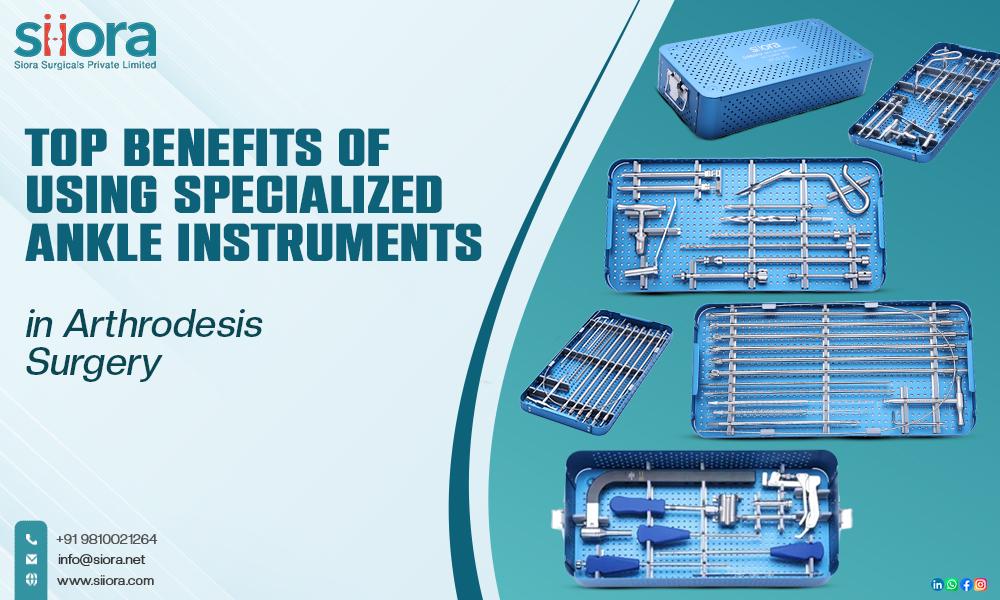
Ankle arthrodesis, often referred to as ankle fusion, is one of those procedures that can transform life for patients living with relentless ankle pain. People who have advanced arthritis, severe injuries, or post-traumatic deformities often find walking unbearable. For them, fusion surgery closes the chapter of constant pain by locking the bones of the ankle together. But while the concept of “fusing” sounds straightforward, carrying it out in the operating room is anything but simple. This is where specialized ankle instruments make a true difference.
Ask any orthopedic surgeon who has done these procedures: having the right set of tools changes the story. Traditional, generic orthopedic kits may cover the basics, but ankle arthrodesis delicate demands handling and precise alignment. Instruments designed specifically for ankle fusion allow surgeons to carry out each step—removing cartilage, shaping bones, and inserting fixation devices—with far more confidence and efficiency.
Cleaner, More Accurate Bone Work
The heart of ankle fusion is in preparing bone surfaces. The smoother and more precise these surfaces are, the greater the chance the bones will unite over time. Specialized reamers and guides are built for this exact purpose. They let the surgeon strip away damaged tissue cleanly without gouging or leaving uneven areas, something that's harder with multipurpose tools.
Think of it like carpentry—two planks only fuse strongly when the joints match perfectly. The same principle applies in the ankle. Specialized tools let that “fit” happen with much greater accuracy.
Getting the Alignment Right
Another critical part of fusion is setting the ankle at the best possible angle. Too steep or too flat, and the patient’s ability to walk comfortably will suffer. Dedicated jigs and alignment tools take the guesswork out and help surgeons position the joint at around 90 degrees. That angle keeps weight distributed properly across the foot and minimizes long-term strain elsewhere in the body.
Patients may never see these jigs or holders, but their effect shows up every single time the patient takes a step after recovery.
Saving Time in the Operating Room
Anyone who has spent time in surgery knows that the clock is always ticking. Longer operating times mean higher risks—blood loss, infections, anesthesia-related complications. Specialized instruments tailored for arthrodesis shorten different stages of the operation. They don’t just make the job easier, they make it faster.
For patients, this means less time under anesthesia and, often, smoother recoveries. For the surgeon, it means less physical strain and more time saved, especially in complex cases.
Stronger Fixation That Lasts
Fusion only works when the bones are locked down in place until healing runs its course. Specialized ankle instruments work hand in hand with fixation implants like plates, screws, or intramedullary nails. Because the tools are engineered for these implants, the fixation is firmer and more reliable.
Better fixation means fewer complications and a lower risk of implant failure, loosening, or misalignment. As a result, patients will experience faster healing and better stability.
Lowering Risks and Complications
Risk is there with every surgery, but proper instrumentation reduces it. Tools made for ankle fusion guide the surgeon’s movements more predictably. They help avoid accidental injury to nearby nerves or blood vessels, which is always a concern in the ankle region. By reducing these risks during the operation, recovery tends to be smoother and less eventful.
Outcomes That Speak for Themselves
At the end of the day, it all comes down to patient outcomes. With specialized ankle instruments, fusion rates improve, pain levels drop, and mobility returns in a way that patients can actually feel in their daily routines. While general instruments can technically complete the job, it’s the specialized ones that sharpen the results and leave patients better off long-term.
Conclusion
Ankle arthrodesis is demanding surgery, but specialized ankle instruments lighten that load. They give surgeons precision, speed, stability, and ultimately deliver what patients want most—lasting pain relief and confidence on their feet again. The procedure may be centuries old, but modern trauma instruments have raised the standard to a level that was once difficult to imagine.

 English
 Arabic
 French
 Spanish
 Portuguese
 Deutsch
 Turkish
 Dutch
Dutch
 Russian
 Romaian
 Portuguese (Brazil)
 Tiếng Việt