


Machine Learning (ML) has become one of the most transformative technologies of the 21st century, powering innovations in artificial intelligence, automation, and data analytics. From personalized recommendations on e-commerce websites to advanced fraud detection in banking, ML applications are everywhere. However, like any technology, it comes with both benefits and challenges.
In this blog, we’ll explore the advantages of machine learning and disadvantages of machine learning to understand its real-world impact.
What is Machine Learning?
Machine Learning is a branch of Artificial Intelligence (AI) that enables systems to learn from data and improve performance without explicit programming. Instead of relying on fixed rules, ML algorithms identify patterns, predict outcomes, and make data-driven decisions.
Some popular examples include:
-
Netflix recommends shows based on your viewing history.
-
Google Maps is predicting traffic patterns.
-
Banks are detecting fraudulent transactions.
-
Virtual assistants like Siri or Alexa understand voice commands.
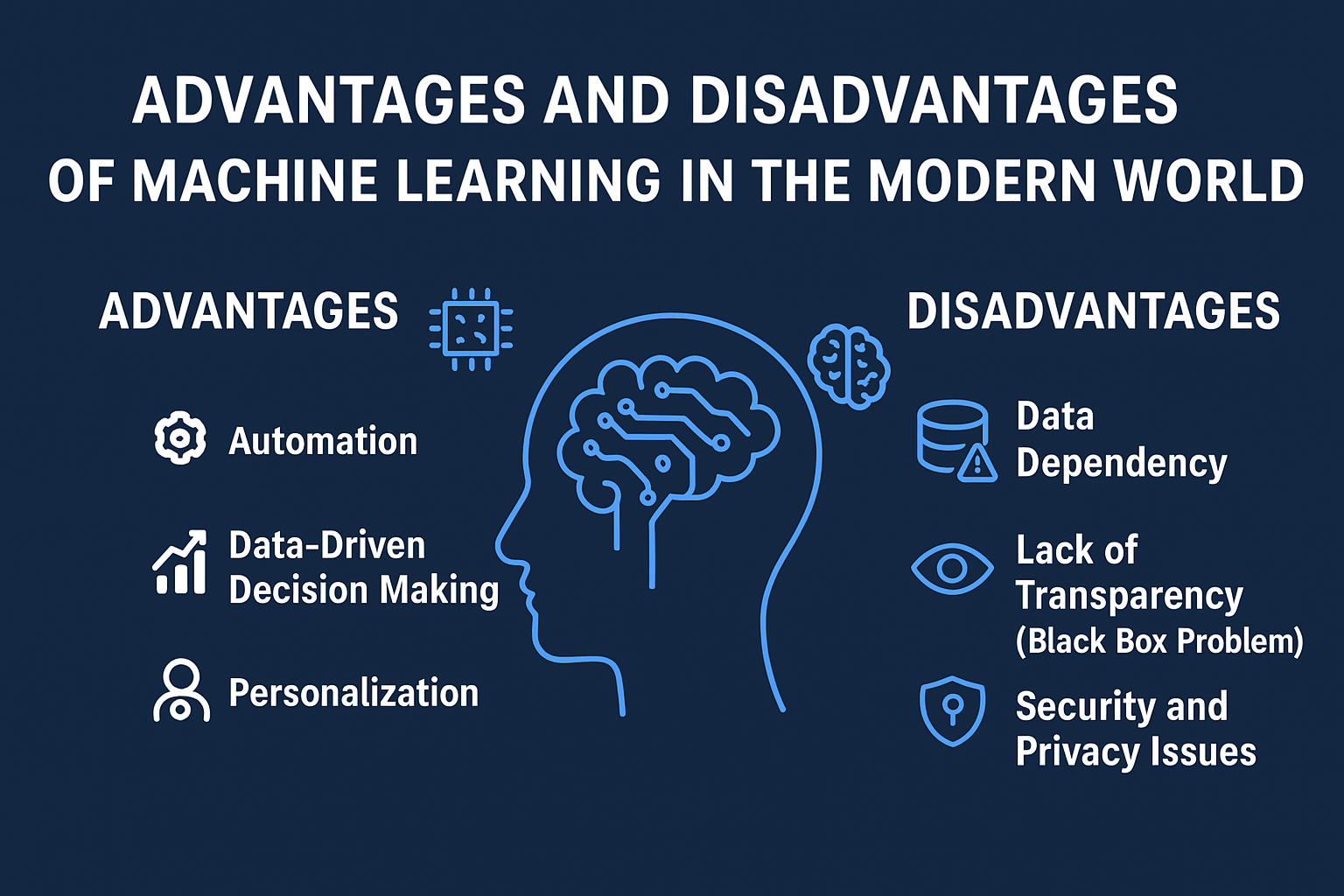
Advantages of Machine Learning
1. Automation of Processes
One of the biggest advantages of machine learning is automation. Tasks that once required manual effort—such as spam filtering, data entry, or quality checks can now be automated with high accuracy. This saves time and reduces human error.
2. Data-Driven Decision Making
ML thrives on data. It can analyze massive datasets, extract insights, and support smarter decision-making. For businesses, this means better forecasting, marketing strategies, and customer engagement.
3. Continuous Improvement
Unlike traditional software, ML models improve as they process more data. This adaptability ensures better performance over time, making systems more accurate and efficient.
4. Personalization
Machine learning powers personalized experiences—whether it’s product recommendations, curated news feeds, or targeted advertising. This enhances customer satisfaction and drives engagement.
5. Handling Complex Data
ML excels at working with unstructured or high-dimensional data, such as images, videos, and natural language. This capability fuels advancements in computer vision, speech recognition, and natural language processing (NLP).
6. Wide Range of Applications
From healthcare and finance to education and entertainment, ML has versatile applications. For example, predictive healthcare models can detect diseases early, while self-driving cars rely heavily on ML for decision-making.
Disadvantages of Machine Learning
1. Data Dependency
A major disadvantage of machine learning is its dependence on data. Poor-quality, biased, or insufficient data can lead to inaccurate predictions and harmful outcomes.
2. High Computational Costs
Training ML models, especially deep learning models, requires significant computational power, storage, and energy. This makes implementation expensive for small businesses.
3. Lack of Transparency (Black Box Problem)
ML models, especially neural networks, often act as “black boxes.” It’s difficult to interpret how decisions are made, raising concerns about accountability in sensitive areas like healthcare or law enforcement.
4. Risk of Bias
If the data used for training contains biases, the model will likely reproduce or even amplify those biases. For example, biased recruitment datasets may result in discriminatory hiring practices.
5. Security and Privacy Issues
Since ML relies on large volumes of data, including personal information, it raises privacy concerns. Cyberattacks targeting ML systems can also manipulate predictions, leading to security risks.
6. Not Always Generalizable
ML models trained for specific tasks may fail when applied to slightly different scenarios. This limitation reduces flexibility in real-world environments.
Real-World Examples of Advantages and Disadvantages
-
Advantage: In healthcare, ML helps detect early signs of diseases like cancer through medical imaging.
-
Disadvantage: In criminal justice systems, predictive policing models have faced criticism for reinforcing racial biases.
Conclusion
Machine learning is a powerful technology that continues to reshape industries and daily life. The advantages of machine learning, such as automation, personalization, and data-driven insights, make it an invaluable tool. However, the disadvantages of machine learning, including data dependency, bias, and high costs, highlight the need for responsible use.
As organizations and individuals adopt ML, it’s crucial to balance innovation with ethical considerations, ensuring that the technology benefits society as a whole.

 Arabic
 French
 Spanish
 Portuguese
 Deutsch
 Turkish
 Dutch
Dutch
 Italiano
 Russian
 Romaian
 Portuguese (Brazil)
 Tiếng Việt