


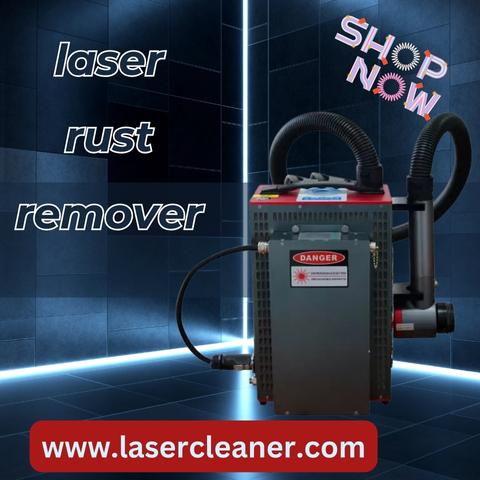
Rust has long been a challenge for industries and craftsmen working with metals. Traditional rust removal methods often involve harsh chemicals, abrasive tools, or time-consuming manual labor. Today, the laser rust remover stands as a groundbreaking solution that combines precision, speed, and safety to restore metal surfaces efficiently. This technology is transforming how professionals approach metal maintenance and restoration, making it indispensable across multiple sectors.
The laser rust remover operates by emitting a focused beam of light that interacts with the rust layer on a metal surface. The laser energy penetrates the oxidized layer, effectively disintegrating rust molecules without affecting the underlying metal. Unlike sandblasting or chemical treatments, the process does not introduce additional mechanical stress or hazardous materials, allowing operators to preserve the integrity of the metal.
Industries ranging from automotive repair to aerospace maintenance are increasingly adopting laser rust removers. For automotive professionals, this technology enables the precise cleaning of car frames, engine parts, and tools that are prone to corrosion. The method allows them to remove rust from intricate components without the risk of damaging sensitive parts, which is often a limitation with conventional mechanical methods.
In industrial manufacturing, the laser rust remover plays a vital role in preparing metal surfaces for coatings, painting, or welding. Clean and rust-free surfaces ensure optimal adhesion of paints and coatings, improving both the durability and appearance of the final product. With laser cleaning, manufacturers can achieve uniform results across large-scale production lines without downtime associated with traditional chemical treatments.
Marine applications also benefit significantly from laser rust removal. Ships and offshore structures constantly face saltwater exposure, which accelerates corrosion. Traditional maintenance requires extensive manual labor and environmental precautions to manage chemical rust removers. With a laser rust remover, operators can efficiently clean large metal surfaces, even in challenging outdoor conditions, while reducing environmental impact.
The process of laser rust removal is highly controllable. Operators can adjust laser intensity, pulse frequency, and scanning speed to match the thickness of rust or the type of metal surface. This precision ensures that every application is tailored to the specific requirement, reducing wastage of energy and time. For metals with complex geometries, the laser can reach corners and edges that are otherwise difficult to clean.
Another significant factor driving the adoption of laser rust removers is their minimal maintenance requirement. Unlike sandblasting equipment that demands frequent replacement of abrasive materials or chemical tanks that require regular disposal, laser systems maintain consistent performance over extended periods. The operational workflow becomes simpler, and operators can focus on the actual cleaning process rather than equipment management.
Safety is also a major advantage in environments that use laser rust removers. Traditional rust removal often exposes workers to harmful dust, chemicals, or flying debris. Laser systems reduce these risks, providing a cleaner and safer working environment. Enclosures or protective eyewear ensure that operators remain shielded from laser exposure, making it suitable for indoor and outdoor applications alike.
From a financial perspective, while the initial investment in a laser rust remover might appear significant, the long-term benefits in operational efficiency, reduced labor costs, and extended lifespan of metal assets often justify the expenditure. Businesses can complete cleaning tasks faster and with higher precision, improving overall productivity.
The versatility of laser rust removers extends to restoration projects, including historic metal artifacts, sculptures, and machinery. Conservationists and restorers can remove rust without compromising the surface details, preserving the historical integrity of artifacts while preventing further degradation.
Laser rust removal technology continues to evolve, with newer systems offering higher power, more compact designs, and integrated automation features. Some models incorporate robotic arms for fully automated rust removal on production lines, while others offer portable designs for fieldwork. This adaptability ensures that users across industries can find a suitable system for their specific needs.
Environmental impact is another important consideration. Unlike chemical rust removers that generate wastewater and require careful disposal, laser systems produce negligible waste. The process primarily vaporizes rust particles, which can then be collected safely. This makes laser rust removal a more sustainable and eco-friendly approach to metal maintenance.
The precision, speed, and adaptability of the laser rust remover are transforming expectations for metal cleaning and maintenance. Professionals can restore surfaces with unmatched accuracy, minimize downtime, and extend the life of metal assets across industries. Its applications span automotive, manufacturing, marine, aerospace, and even cultural restoration, proving its wide-ranging effectiveness.
As industries continue to prioritize efficiency, quality, and sustainability, laser rust removal stands at the forefront of modern metal care technology. The ability to combine fast, precise cleaning with minimal environmental impact makes it a forward-looking choice for businesses and professionals aiming to maintain high standards in metal maintenance.
Final Thoughts
The laser rust remover represents a leap forward in surface cleaning technology. Its precision, adaptability, and safety make it a compelling tool for professionals across diverse industries. By eliminating rust effectively while preserving the underlying metal, it offers a modern solution that enhances efficiency, protects resources, and ensures superior results.

 Arabic
 French
 Spanish
 Portuguese
 Deutsch
 Turkish
 Dutch
Dutch
 Italiano
 Russian
 Romaian
 Portuguese (Brazil)
 Tiếng Việt