


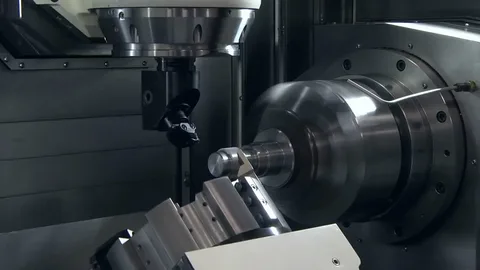
In today's competitive manufacturing landscape, businesses are constantly looking for ways to optimize production while maintaining high quality. One effective solution is leveraging precision machining services. These services, which involve advanced manufacturing techniques and highly accurate machinery, are designed to produce components with exact specifications. By adopting precision machining, companies can minimize errors, reduce material waste, and ultimately lower production costs. This article explores how precision machining services can be a cost-saving strategy for manufacturers.
Minimizing Material Waste
One of the most significant ways precision machining services reduce production costs is through minimizing material waste. Traditional manufacturing methods often result in excess material being discarded due to inaccuracies or errors during the production process. Precision machining, however, uses advanced computer-controlled equipment to ensure that every cut, drill, or mill is exact. This accuracy drastically reduces scrap material, which translates directly into cost savings.
Additionally, precision machining allows manufacturers to optimize material usage by planning the most efficient cuts and shapes. By using CAD and CAM software in tandem with precision machinery, companies can design components that require less raw material without compromising quality. This not only reduces material costs but also aligns with sustainable manufacturing practices, enhancing the company’s environmental profile while cutting expenses.
Enhancing Production Efficiency
Efficiency is another area where precision machining services significantly impact cost reduction. Machines used in precision machining, such as CNC (Computer Numerical Control) machines, can operate continuously with minimal human intervention. This reduces the time required to produce each component, speeding up the manufacturing process and allowing for higher production volumes in less time.
Moreover, precision machining reduces the need for extensive rework or adjustments due to errors. Traditional manual processes often require multiple rounds of correction, which not only consumes time but also increases labor costs. By producing accurate parts on the first attempt, precision machining ensures smoother production cycles and lowers overall operational costs.
Improving Product Quality and Consistency
High-quality, consistent products are essential in avoiding costly returns and warranty claims. Precision machining services provide superior accuracy, ensuring that each component meets exact specifications. This reduces the likelihood of defects that could result in financial losses or damage to a brand’s reputation.
Consistency in production also allows for better inventory management and planning. When parts are uniform, assembly lines run more smoothly, and manufacturers can avoid disruptions caused by mismatched or faulty components. This reliability minimizes the hidden costs associated with production delays, scrap parts, and customer dissatisfaction, making precision machining a financially prudent choice.
Reducing Labor and Maintenance Costs
Investing in precision machining services can also lower labor costs. Traditional machining often requires highly skilled operators to monitor and adjust equipment constantly. In contrast, precision machining systems, especially those that are automated, require less manual intervention. Fewer operators are needed, and those who are involved can focus on higher-value tasks, enhancing overall productivity.
Maintenance costs are similarly reduced. Precision machines are engineered for reliability and longevity, meaning they experience fewer breakdowns and require less frequent servicing. The result is lower downtime and reduced expenditures on repairs or emergency maintenance. By decreasing both labor and maintenance costs, precision machining services contribute significantly to overall cost savings in production.
Enabling Flexible and Scalable Production
Finally, precision machining services allow manufacturers to be more flexible and scalable, which translates to cost efficiency. Advanced machining technology can quickly adapt to different designs and production volumes without requiring significant retooling or setup changes. This flexibility allows manufacturers to respond to market demand more efficiently and avoid costs associated with overproduction or idle machinery.
Scalability is another benefit, as precision machining systems can handle both small batches and large-scale production with the same level of accuracy. Companies can scale operations up or down according to demand without compromising on quality or efficiency. This adaptability ensures that resources are used optimally, reducing wasted expenditures and making production more cost-effective.
Conclusion
Incorporating precision machining services into manufacturing processes is a strategic way to reduce production costs while maintaining high standards of quality. From minimizing material waste and improving efficiency to enhancing product consistency, reducing labor and maintenance costs, and enabling scalable production, the benefits are substantial. For businesses seeking to stay competitive in a cost-conscious market, investing in precision machining is not just a choice—it’s a pathway to sustainable, efficient, and profitable manufacturing.

 Arabic
 French
 Spanish
 Portuguese
 Deutsch
 Turkish
 Dutch
Dutch
 Italiano
 Russian
 Romaian
 Portuguese (Brazil)
 Tiếng Việt